
How to Combine Multiple Gemstones Without Overdesigning
A design-first framework for combining several gemstone materials while keeping the bracelet coherent, wearable and personal.
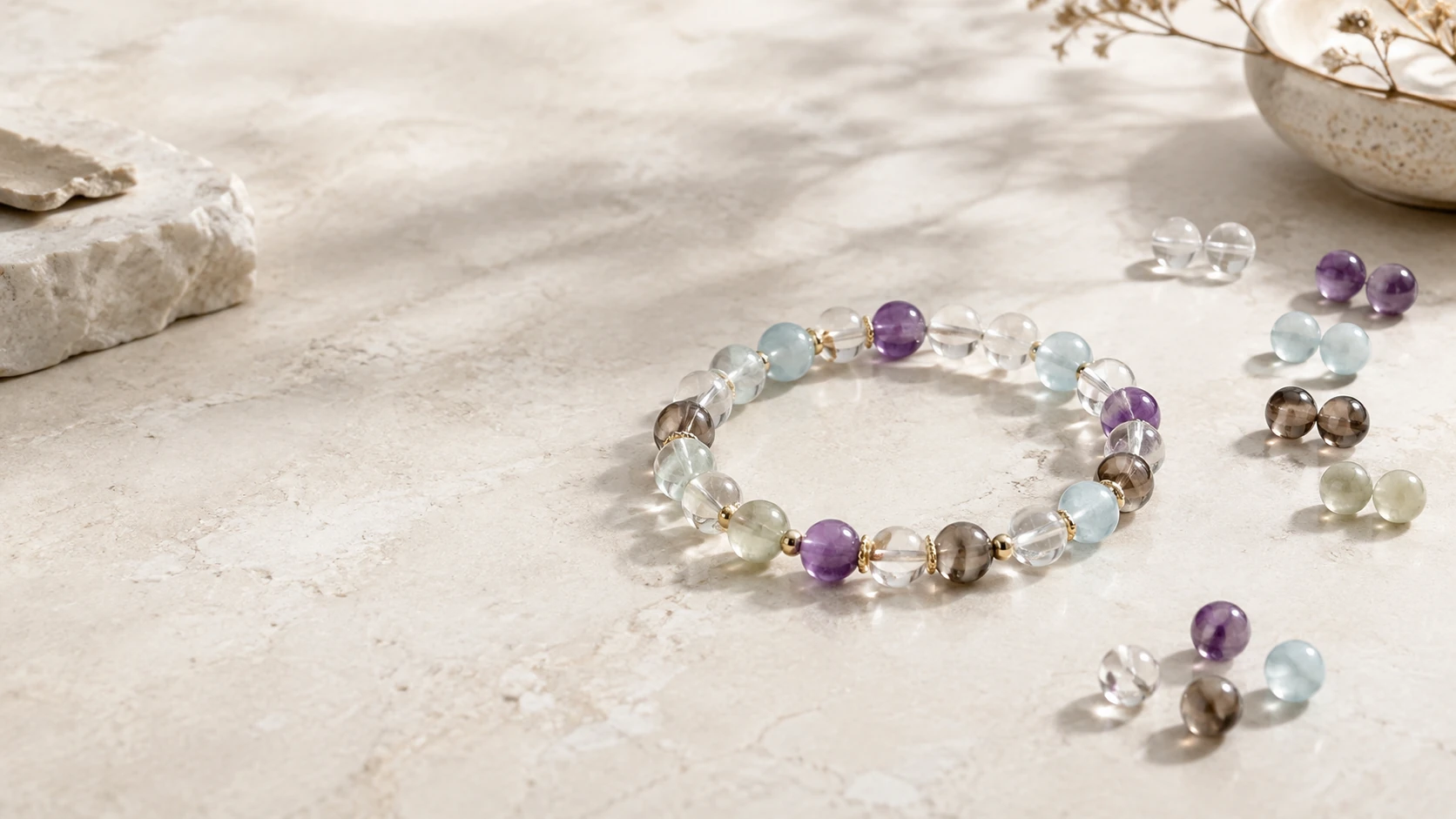
The freedom to choose from many gemstones can make it tempting to add one of everything. But variety and complexity are not the same as good composition.
More Materials Do Not Automatically Create More Design
The freedom to choose from many gemstones can make it tempting to add one of everything. But variety and complexity are not the same as good composition.
A bracelet becomes easier to understand when the materials have hierarchy. One stone can carry most of the visual weight. Another can create contrast. A third can connect sections or introduce a focal moment.
When every gemstone is treated as equally important, the bracelet can lose rhythm and start to feel like a sample tray rather than a finished design.
Choose a Dominant Material
Begin with the stone that defines the bracelet.
The dominant material does not necessarily need to occupy more than half of the bracelet, but it should be the material the eye recognizes as the main direction. It might lead through color, repetition, visual weight or placement.
For example, a bracelet dominated by aquamarine can use clear quartz as a transition and citrine as a small warm accent. The design remains “blue-led” even though more than one material is present.
Give Supporting Stones a Job
Every additional gemstone should contribute something specific.
A supporting stone can soften the main color, increase contrast, repeat a texture, create a transition or frame a focal bead. If you cannot explain what a new material adds visually, the bracelet may not need it.
This is a useful editing test because overdesign usually comes from additions that are individually attractive but collectively unnecessary.
Keep Bead Size Consistent When You Want Cohesion
Using the same nominal bead size across several gemstone types is one of the easiest ways to make a mixed-material bracelet feel unified.
When diameter stays consistent, color and natural texture can change without disrupting the physical rhythm. This is especially effective for TerraBead designs built from smooth round beads.
Mixing sizes can also work, but it creates another layer of hierarchy. A larger bead immediately becomes more visually important, so size changes should be intentional rather than random.
Use One Focal Point, Not Five
A charm, a larger bead, a rare color or a contrasting material can all act as focal points.
The problem begins when several focal devices compete at the same time. A bracelet with multiple large beads, multiple charms, frequent metal accents and several high-contrast colors can become difficult to read.
Choose one main focal idea. Other elements should support it rather than compete with it.
Repetition Makes Complexity Feel Intentional
Repetition is one of the strongest tools for controlling a multi-gemstone design.
If three gemstones are used, repeat them in a recognizable sequence. If the arrangement is asymmetrical, repeat at least one color or material in several locations so the eye can connect the composition.
Even a loose, organic-looking bracelet benefits from repeated visual cues. They make variety feel designed rather than accidental.
Know When to Use Symmetry
Symmetry creates immediate order. It is useful when a bracelet contains several colors or when a central charm needs to feel anchored.
Asymmetry creates more movement and individuality but requires stronger judgment. If you use an asymmetrical layout, maintain balance through color weight, repeated materials or spacing rather than mirroring every bead exactly.
Neither approach is superior. The right choice depends on whether you want the bracelet to feel controlled or spontaneous.
Metal Can Connect Different Gemstones
Metal spacers can function as a visual system across otherwise different stones.
Repeating the same spacer finish between selected beads creates consistency. Gold-toned details can warm a mixed palette, while silver-toned details can keep cool colors feeling crisp.
Metal should not become an automatic separator between every bead unless that rhythm is intentional. Use it as one more design element, not as a default solution.
Edit by Removing
When a design feels unresolved, the instinct is often to add another bead or color. A better approach is usually to remove one element.
Ask three questions:
If the answer to the third question is obvious, remove it. Restraint is not the absence of creativity; it is the process that makes the creative decision visible.
· Which material is the main idea?
· Which materials are helping that idea?
· Which material could disappear without weakening the design?
A Practical Four-Step Framework
Use this framework when designing with multiple gemstones:
1. Lead — choose the dominant stone or color direction.
2. Support — add one material that reinforces or contrasts with the lead.
3. Connect — use a neutral, spacer or repeated pattern to create continuity.
4. Edit — remove anything that competes without adding a clear role.
This gives you enough structure to create a coherent bracelet without making every design look the same.
Frequently Asked Questions
How many gemstone types can I use in one bracelet?
There is no fixed maximum, but two to four materials are easier to organize clearly. More materials require stronger repetition and hierarchy.
Should all gemstones be the same bead size?
They do not have to be, but a consistent bead size creates cohesion. Size changes automatically create focal points and should be used intentionally.
Is a symmetrical bracelet better than an asymmetrical one?
No. Symmetry creates order; asymmetry creates movement. Both can work when the visual balance is deliberate.
How do I know if my bracelet has too many elements?
If no single material, rhythm or focal point feels dominant, the design may be overworked. Try removing one color, charm or spacer pattern.
Can metal spacers help tie different gemstones together?
Yes. Repeating one metal finish can create continuity across several gemstone colors and textures.
Design It Your Way
Start with these ideas and build a bracelet that feels like you in TerraBead Design Studio.