
How Many Beads Do You Need for a Bracelet?
A practical guide to estimating bead count by wrist size, bead diameter, spacers and bracelet layout.
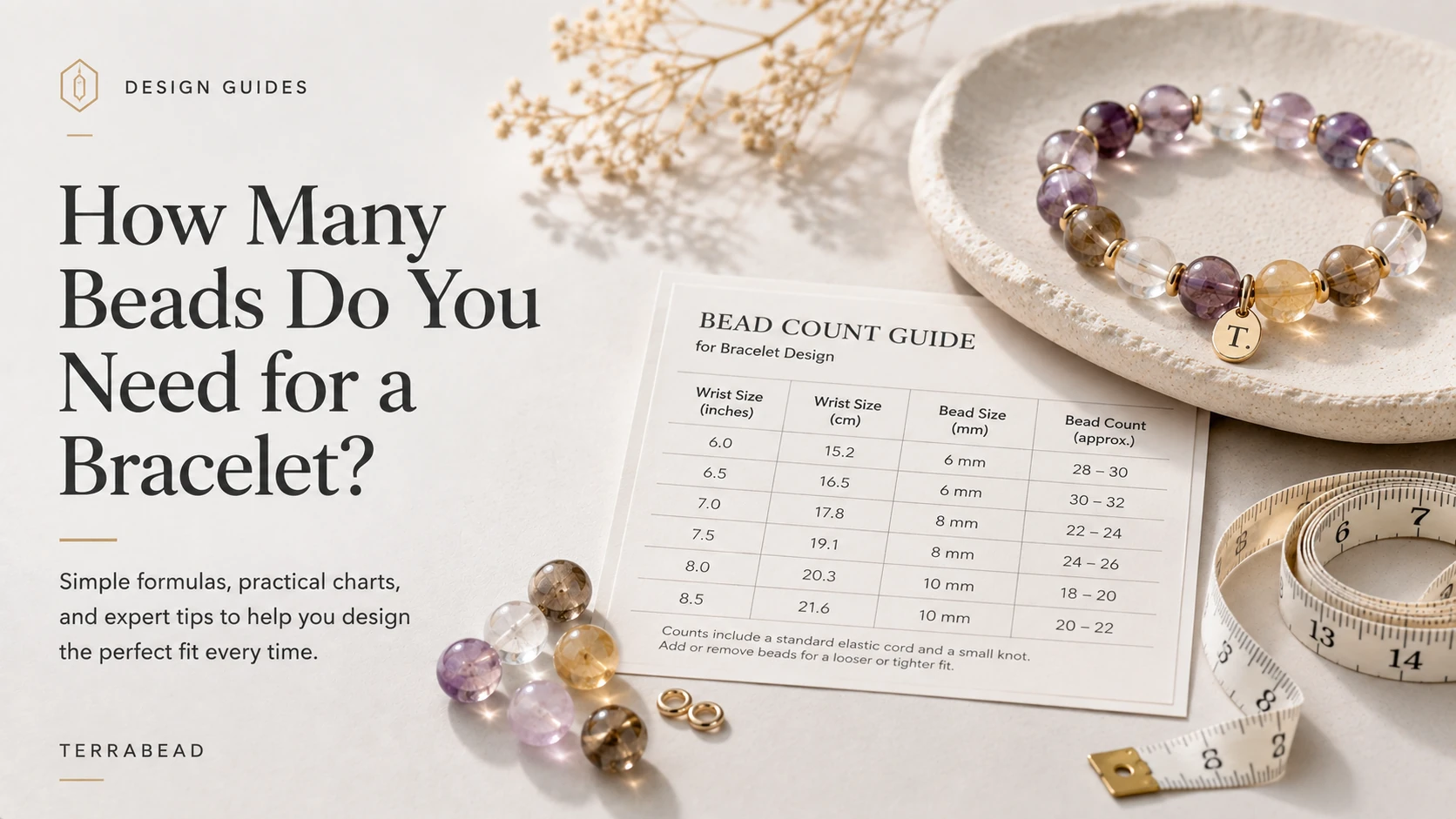
A bracelet is a circle built from physical objects, not a fixed number of pieces. The bead count changes whenever wrist size, bead diameter or component spacing changes.
There Is No Single Bead Count for Every Bracelet
A bracelet is a circle built from physical objects, not a fixed number of pieces. The bead count changes whenever wrist size, bead diameter or component spacing changes.
A bracelet made with 6mm beads may use many more beads than a bracelet made with 12mm beads, even when both are designed for the same person. Adding metal spacers, a charm connection or accent beads also changes the total.
For that reason, the useful way to plan a bracelet is to work from circumference and material dimensions rather than memorizing one universal bead count.
The Basic Estimation Method
Start with the target bracelet circumference. This is the wrist measurement plus the amount of ease needed for the desired fit.
Then estimate how much length each bead occupies along the bracelet. For a simple round-bead bracelet with very little spacing, the bead diameter provides a practical first approximation.
A simplified planning formula is:
Estimated bead count = target bracelet circumference ÷ average bead spacing
For example, a design built with 10mm beads will usually need roughly half as many beads as a design built with 5mm beads over the same circumference. The exact finished count still needs to be adjusted during assembly.
Why the Final Count Can Differ
Nominal bead size is not the same as perfect machine-level uniformity. Natural gemstone beads can have small dimensional differences, and the drill path may not always pass through the exact geometric center.
Spacers also matter. Even a thin metal spacer adds length. A bracelet with a spacer between every bead may require noticeably fewer gemstone beads than a bracelet built only from stone.
Charms and connector rings can introduce additional space as well. The more components you add, the less useful it becomes to think only in terms of a pure “number of beads” formula.
Planning by Bead Size
As bead diameter increases, the total bead count falls and the design becomes visually stronger.
6mm beads create a finer rhythm and allow more individual units around the wrist. They are useful for subtle color transitions and detailed patterns.
8mm beads are versatile and give enough surface area for natural gemstone character to remain visible without becoming visually dominant.
10mm beads create a stronger presence and make each stone more important in the composition.
12mm and 14mm beads reduce the number of pieces further and create a more sculptural result. At these sizes, fit and interior circumference deserve extra attention because the beads project farther inward toward the wrist.
Spacers Change Both Count and Rhythm
Spacers are not only decorative. They create physical distance between beads and alter the rhythm of the design.
Using a spacer after every bead produces a more segmented, jewelry-like structure. Using spacers only at focal points keeps the stone sequence more continuous. A single charm connector can create an intentional visual break.
When estimating bead count, include every repeating component that occupies space around the bracelet.
Symmetry Can Determine the Count
If you want a perfectly symmetrical bracelet, the design structure may matter more than the mathematically exact bead count.
For example, a bracelet with one central charm may look best when the same number of beads appears on both sides. A repeated three-color sequence may need the total bead count to be divisible by three. A mirrored design may need an even number of beads around a central focal point.
In these cases, adjust the count to preserve the pattern, then fine-tune fit through spacer thickness, bead size or the exact length of the elastic construction.
Natural Variation Is Part of the Calculation
A nominal 10mm natural gemstone bead is a useful category, but individual beads may vary slightly. That variation is normal and can affect a tightly calculated layout.
The final bracelet should therefore be treated as a physical composition, not a spreadsheet result. Estimate first, arrange the full sequence, check the inside circumference, and then make small adjustments before finishing.
The Design Studio Approach
TerraBead Design Studio is designed around visual composition rather than forcing the customer to calculate every component manually. The ideal system uses wrist size, bead size and selected components to help estimate whether a design is physically appropriate while still allowing creative freedom.
For the user, the principle is simple: choose the materials and rhythm you want, but understand that each design decision occupies real space on the bracelet.
Frequently Asked Questions
How many 10mm beads do I need for a bracelet?
The exact number depends on the target bracelet circumference and whether spacers or other components are included. Use circumference divided by the average occupied length per bead as an estimate, then adjust during assembly.
Do spacers reduce the number of gemstone beads I need?
Usually, yes. Spacers occupy physical space around the bracelet, so a design with frequent spacers generally uses fewer gemstone beads.
Why does my calculated bead count not fit perfectly?
Natural bead-size variation, drill position, spacer thickness, knot or connector space and the difference between outer and inner circumference can all affect the finished fit.
Should a symmetrical bracelet use an even number of beads?
Not always. It depends on whether the design has a central focal element and how the pattern repeats. Symmetry is a layout decision, not simply an even-versus-odd rule.
Is bead count more important than bracelet circumference?
No. Circumference and fit are the primary physical requirements. Bead count is the result of those measurements plus the chosen design.
Design It Your Way
Start with these ideas and build a bracelet that feels like you in TerraBead Design Studio.